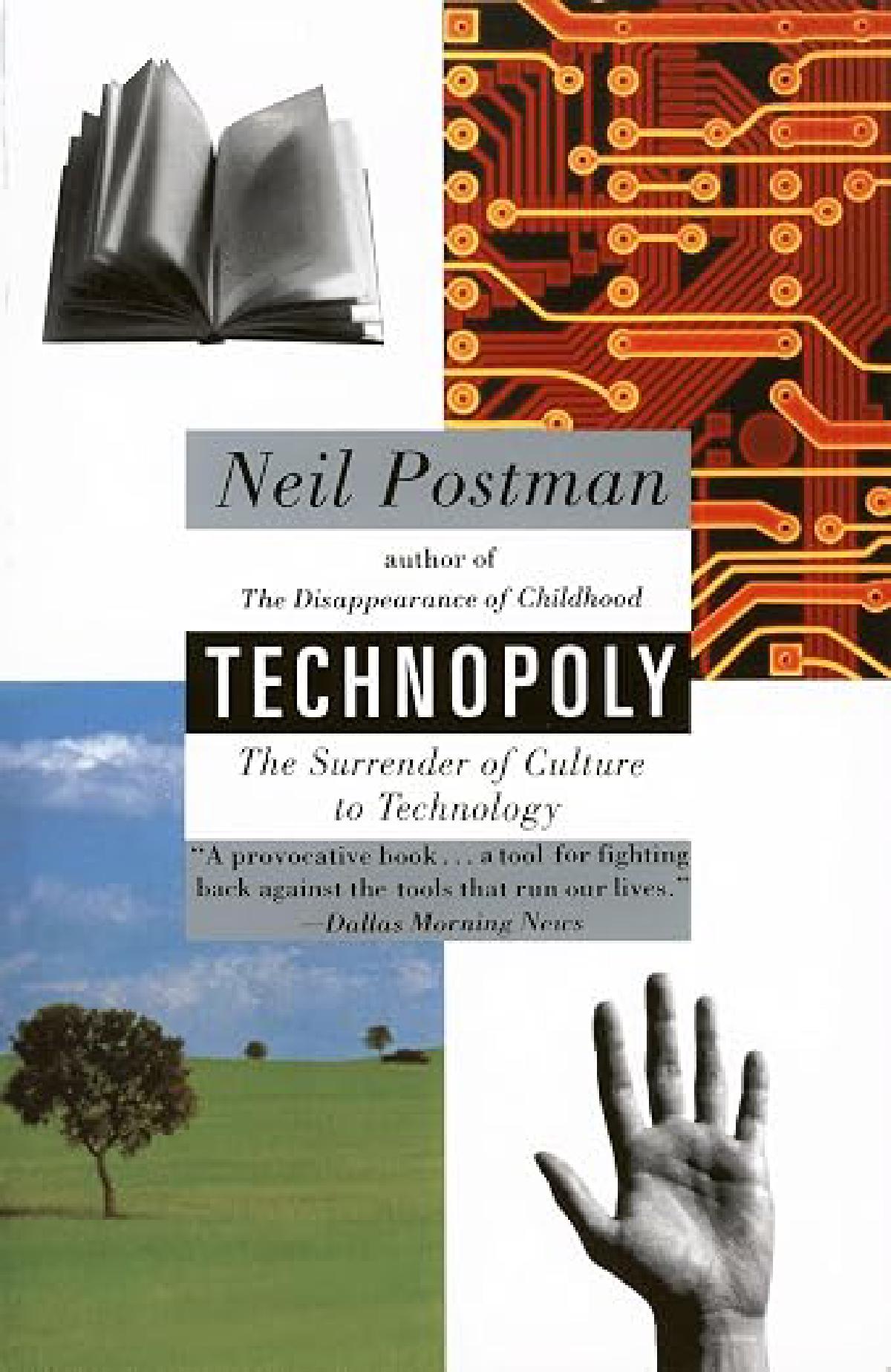

Neil Postman published Technopoly in 1992, a year when the World Wide Web was a research project and Artificial Intelligence referred to chess engines that could beat a human player on a good day. Reading it now in 2026, in the middle of the largest tech bubble since the dot-com era, Neil’s book feels strangely prophetic and poignant as the world reconsiders how much we want to allow technology to run our lives.
Postman’s central claim is that society passes through several stages in its relationship with technology. First you have a tool-using culture, where technology helps us achieve goals our culture already holds. Our society then gradually evolves into a technocracy, where technology starts to reshape our goals. We then ultimately reach a state of technopoly, where our culture surrenders entirely to technology, where the only questions worth asking about a new technology are how to adopt it faster and measure it better. He observes several key symptoms of social decay that have been amplified in our current technologically-focused world.
Postman warns us about the creep of metaphors in our daily language within a technopoly. We have already started to describe people as machines, that we get “programmed” or “hard-wired” or run out of “bandwidth.” This type of language is reductive of humanity, and it quietly trains us to accept a thinner picture of what a human being is. It’s become increasingly common in San Francisco and talking to techies to now casually say a person needs to “update their priors” or that someone’s “context window” is full. The metaphor has won so thoroughly that we no longer notice it is a metaphor, and it has induced a very specific type of brain rot.
Technology not only infects our language but pollutes our information economy and strips us of our attention. Postman argued that when information is so freely created in a technopoly, it stops being a resource and starts being a kind of pollution once it floods past the institutions built to filter it. The institutions that gave information meaning, that decided what was worth knowing, got overwhelmed and then trivialized. An AI that can generate a plausible paragraph on any topic in any style on demand is the purest expression of information-as-flood that has ever existed.
Postman’s sharpest prediction is about religion. He argued that a technopoly does not abolish the sacred, so much as relocate it onto technology. The discourse nowadays around AGI, the exponential, and the coming singularity has taken an openly theological shape: an omniscient intelligence that will cure disease and death and automate all labour, spoken about in the cadence of prophecy. AI has stopped being described as a tool and started being described as a coming god. This inevitability and mysticism is not an accident, in my cynical opinion. The same handful of AI labs and tech giants racing to build these systems are purposefully authoring the mythology around them. It justifies almost unlimited capital investment and frames the concentration of power as a safety necessity, because who else can be trusted to control a god. It recasts ordinary corporate accumulation as stewardship of humanity’s future. I cannot prove that this deification is deliberate, but you do not need a conspiracy when incentives line up this cleanly. The theology flatters the builders, attracts the capital, and softens the public into accepting an extraordinary transfer of wealth and control toward whoever owns the models.
Then you reach the final chapters, and the book becomes an artifact of its author’s time and place. Postman calls for “loving resistance fighters” who hold sacred the symbols that once made the United States the hope of the world. His remedy is a school curriculum built around the Western canon, American civic symbols, and quasi-religious cultural continuity. I find this problematic because he treats the Western Judeo-Christian and American narrative as the natural answer. He worries that admitting that story is partial would make education “a tribal affair.” To much of the world, and much of his own country, that just describes reality. The single unifying narrative he mourns was itself a mechanism of exclusion for the ruling class of his era. In the age of the Internet and AI, a defense built around preserving one civilization’s symbols cannot scale to a generation that belongs to all of them at once and is bound to none. We’ve already started to see this with Gen Z’s quiet revolt against technology, actively logging off social media, adopting simplified “dumbphones,” and refusing to use generative AI in the workplace. Rather than falling back onto historical symbols, we can choose to build our own.