
The Conway-Kochen Free Will Theorem#
In 2006, John Conway and Simon Kochen proved a result with a deliberately provocative name: ‘The Free Will Theorem’. Granting a few uncontroversial assumptions, they showed that if humans have free will, so do elementary particles. Here’s what I learned with the help of Claude AI.
What It Says#
Two scientists, far apart, each measure one half of a pair of entangled particles whose properties were linked at the moment of creation. Each measurement returns a 0 or 1. Where do the numbers come from? A natural guess is that the answer was already there, baked into the particle’s history. This is commonly referred to as a hidden variable. The Free Will Theorem says this can’t be the case. If the scientists are free to choose what to measure, the particles can’t have any hidden variables either. Their argument rests on three axioms. When you measure a spin-1 particle’s squared spin along three perpendicular directions, you always get two 1s and one 0 in some order. Second, two entangled particles measured along the same direction give the same answer. Third, no information travels faster than light.
The Proof#
Suppose the particle’s response is a hidden variable of past information plus the scientist’s chosen direction. By the second claim, both entangled particles use the same function. By the third, neither function can depend on what the other scientist chose, since no signal would arrive in time. So each particle’s response is determined by its own scientist’s choice alone. This means there must be a way to preassign a 0 or 1 to every direction in space, with any three perpendicular directions getting the values 1, 1, 0. The Kochen-Specker theorem from 1967 says no such assignment exists. Picture trying to color every direction either black or white, with the rule that any three mutually perpendicular directions get two whites and one black. The directions aren’t independent. Picking one constrains many others, and 33 directions are enough to force a contradiction. So the hidden function can’t exist.
The theorem ultimately proves a conditional: if humans have free will, then particles do. Conway argued the antecedent on three inductive grounds. Science presupposes free will, since there’s no coherent way to do experiments without choosing them. Free will is irreducible, since you can’t define it without smuggling it back in. And there’s been no positive evidence for determinism since quantum mechanics arrived. The older physics that looked deterministic (Newtonian mechanics, general relativity, statistical entropy) doesn’t actually pick a direction of time. Accept all of this and the theorem closes the loop. We have free will, so do the particles.
The Rebuttal#
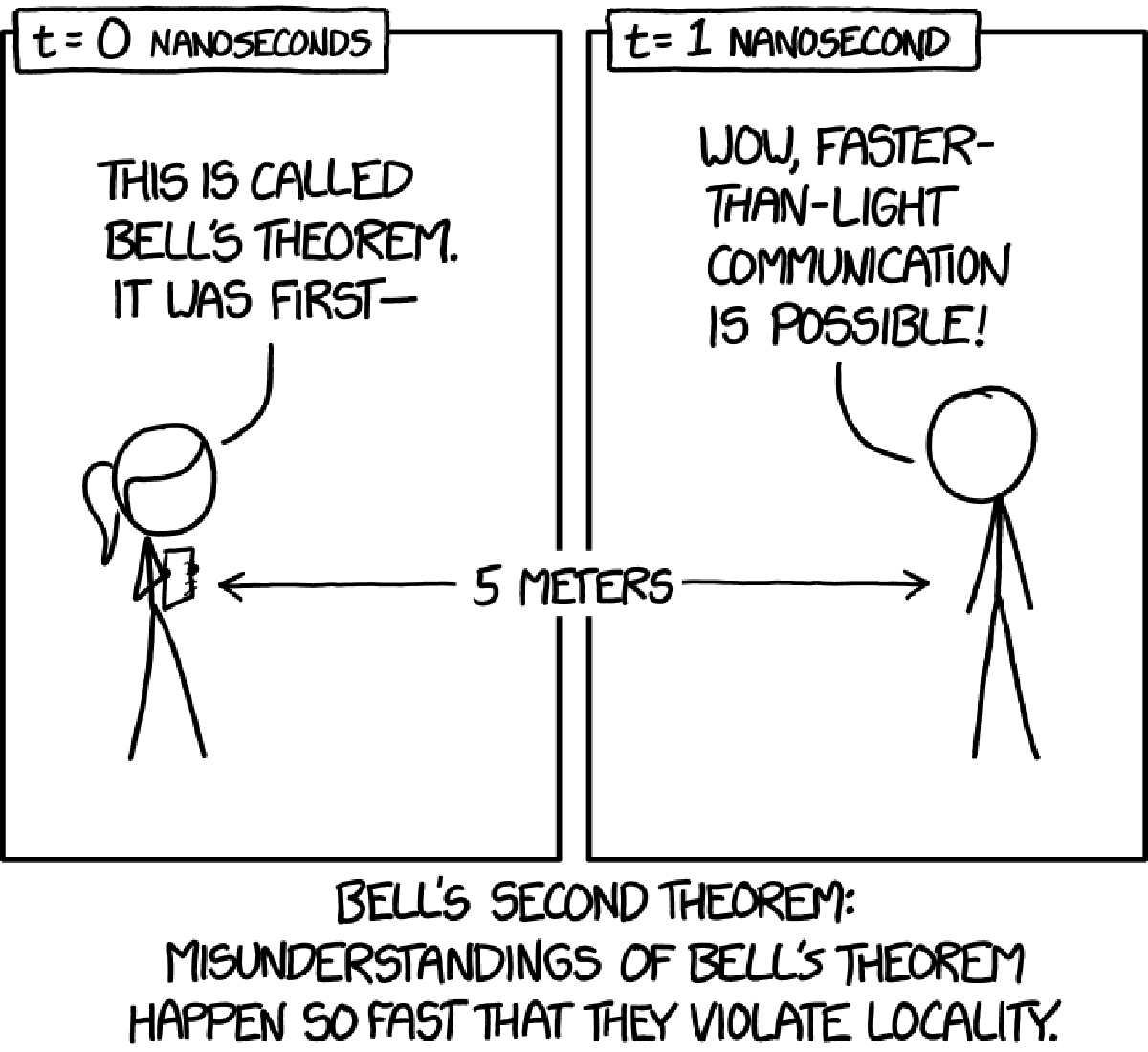
In 2010, Sheldon Goldstein, Daniel Tausk, Roderich Tumulka, and Nino Zanghì argued in the same journal that the popular reading overstates what the theorem shows. Their proof only rules out deterministic hidden variables. Conway and Kochen tried to extend it to random ones with the slogan “randomness can’t help,” arguing you could convert any random model into a deterministic one by pre-rolling all the dice. The critics point out that this conversion breaks the third assumption. The pre-rolled dice end up depending on both scientists’ choices, which the original random model avoided. There are explicit random theories that satisfy all three assumptions, including the simplest one of all: just use quantum mechanics’ own predictions, with no hidden variables. The bigger problem is that the deterministic version isn’t really new. Bell’s 1964 theorem already showed that no local deterministic hidden variable theory can reproduce quantum predictions. For deterministic models, the third assumption (no faster-than-light influence on outcomes) is essentially Bell’s locality condition. So the deterministic core of the Free Will Theorem is a special case of Bell’s theorem. The earlier result already did the work. Quantum mechanics rules out a deterministic universe of a certain kind, but Bell already knew that. The Free Will Theorem doesn’t show that randomness can’t account for what we see. The headline “particles have free will” only sticks on a non-standard reading of the third assumption, one that treats random outcomes as if they were deterministic.
Conway’s inductive arguments for free will stand on their own, but the theorem isn’t doing the work the framing suggests. The universe at small scales is not deterministic, and Bell taught us that. Whether to call that free will is mostly a question about semantics.